Choosing the right Mig Wire With Flux requires more than comparing spool prices. Welding performance depends on wire chemistry, shielding method, diameter, tensile strength, and jobsite conditions. For global buyers, the wrong selection can create excessive spatter, unstable arcs, poor penetration, or costly rework.
Industry research supports this careful approach. MarketsandMarkets’ Welding Equipment Market report identifies automation, infrastructure investment, and manufacturing expansion as major demand drivers. Grand View Research also highlights construction, transportation, and heavy fabrication as important welding applications. These trends increase demand for consistent flux-cored consumables that perform reliably across different machines and working environments.
Technically, many products called “MIG wire with flux” are flux-cored arc welding wires, rather than conventional solid MIG wire. AWS A5.20 and AWS A5.36 provide widely recognized classifications for carbon-steel and stainless-steel flux-cored electrodes. ISO 17632 offers another important reference for cored electrodes used with or without shielding gas. Certification matters.
So does field experience.
This guide compares ten practical options using criteria such as arc stability, slag removal, weld appearance, feeding behavior, packaging, and compatibility with common polarity settings. It also considers outdoor fabrication, where wind can disturb shielding gas, and workshop production, where clean feeding saves time. However, no ranking fits every buyer. A wire that performs smoothly on 6 mm steel may behave differently on thin sheet. Brand reputation helps, but it cannot replace a test weld. That limitation deserves attention. Global sourcing also requires checking mill certificates, technical data sheets, storage conditions, and regional compliance before purchase.
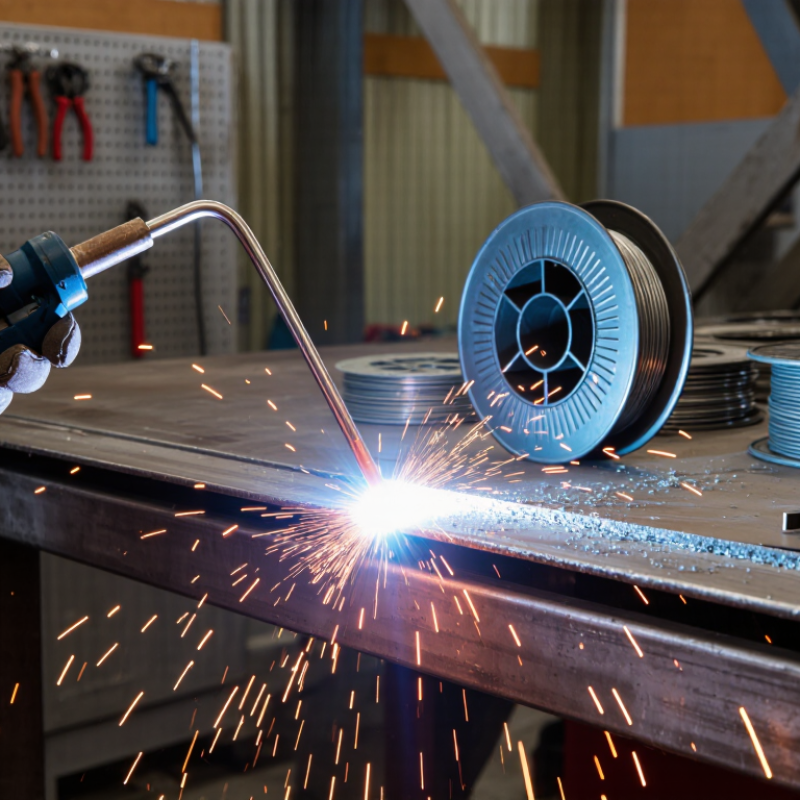
Flux-cored MIG wire is a hollow metal electrode filled with powdered flux. As the wire melts, the flux reacts inside the arc. It produces shielding gases and a protective slag layer over the cooling weld pool. This design helps protect molten steel from oxygen and nitrogen, which can cause porosity and weak beads. Some flux-cored wires work without external gas. Others require shielding gas, so the wire type must match the machine setup.
In practical welding, the feeder pushes wire through the gun at a steady speed. The arc melts the wire and joins the base metals. Heat, wire speed, travel angle, and polarity control penetration and bead shape. A self-shielded wire often suits outdoor repairs because wind can disturb gas coverage. A gas-shielded wire may create a cleaner bead in a controlled workshop. Slag must be chipped and brushed away between passes. Do not skip that step.
I check the wire for rust, moisture, and crushed sections before loading it. Small problems can cause spatter or unstable feeding. Keep the spool dry and covered. Settings printed on a package are useful, not sacred; plate thickness and joint fit can change the result. I often begin with a short test bead, then adjust one setting at a time. The process is forgiving, but not careless. PPE, ventilation, and correct grounding remain essential around every arc.
Global demand makes flux-cored MIG wire comparison more important than simple price checking. The World Steel Association reported approximately 1.89 billion tonnes of crude steel production in 2023. That scale supports diverse welding conditions, from outdoor structural work to automated fabrication cells. Buyers should compare wire classification, shielding method, diameter, deposition rate, and storage requirements together.
ISO 17632 and AWS A5.20/A5.36 classifications help verify tensile strength, impact performance, and usability. E71T-1-type wires may suit gas-shielded structural welding, while self-shielded types can perform better in windy field conditions. However, “all-position” does not mean effortless. Joint fit-up, travel angle, and slag removal still affect the result. AWS Welding Handbook guidance indicates that deposition efficiency varies by process and operating conditions, so a quoted kilogram-per-hour figure needs practical testing.
Look beyond strength numbers. Check the recommended polarity, gas mixture, operating current, and hydrogen-control requirements. A wire can pass a laboratory test yet create excessive spatter on a poorly grounded workpiece. That detail is often missed. Storage matters too; moisture exposure can increase porosity and hydrogen-related risk. I have seen purchasing teams choose a larger spool to reduce handling, then lose savings through unstable feeding and unused wire. A short trial should measure arc stability, bead profile, slag release, visible defects, and actual wire consumption. The cheapest wire is not always the lowest-cost wire. Tensile strength alone is an incomplete comparison.
Flux-cored MIG wire remains practical for structural steel, repair work, shipbuilding, and outdoor fabrication. The World Steel Association reported 1.89 billion tonnes of crude steel production in 2023. That scale supports steady demand for reliable welding consumables. Global buyers should compare the ten best wire options by classification, shielding method, diameter, and operating position.
Gas-shielded wires, such as E71T-1 classifications, often provide clean beads and stable penetration in controlled workshops. Self-shielded wires, including E71T-8 types, suit windy sites because they do not require external gas. AWS A5.20 and ISO 17632 offer useful classification references.
Check tensile strength, impact performance, polarity, and recommended amperage before purchase. Small details matter.
A 0.9 mm wire can suit lighter fabrication
1.2 mm and 1.6 mm wires support thicker plate and higher deposition rates
Keep opened spools dry. Moisture can increase porosity, spatter, and inconsistent arc behavior. The U.S. Bureau of Labor Statistics projects about 42,600 annual openings for welders, cutters, solderers, and brazers from 2023 to 2033. That workforce data highlights the value of simple, repeatable wire selection.
Still, no wire performs perfectly everywhere. Local steel chemistry, machine condition, operator skill, and ventilation can change results. This is where product testing should challenge catalog claims.
10 Best MIG Wire With Flux for Global Buyers
Choosing flux-cored MIG wire starts with the base metal, not the price. Mild steel often suits self-shielded wire for outdoor repairs and windy sites. Gas-shielded flux-cored wire can produce cleaner welds in workshops with stable shielding gas. Stainless steel needs a compatible stainless flux-cored grade, while aluminum usually requires solid wire and gas protection. Do not force one wire to handle every metal. It usually ends badly.
Wire diameter should match the material thickness, machine output, and welding position. Thin sheet may need smaller wire and lower amperage to reduce burn-through. Heavy plate needs higher deposition and deeper penetration. Check the wire classification, polarity, shielding requirements, and recommended voltage before purchase. Packaging matters too. Damp flux can cause porosity, unstable arcs, and weak welds. I once selected wire by diameter alone, and the result looked acceptable but failed during inspection. That mistake changed my buying process.
Tips: Clean rust, paint, and oil before welding. Store opened spools in a dry cabinet. Test a short bead on scrap metal first. Watch the arc sound and bead shape. A steady crackle is useful, but it is not proof of strength. Compare the supplier’s technical datasheet with your local welding procedure and safety requirements. Small differences in standards can create large problems across markets.
Flux-cored MIG wire needs careful storage before it reaches the welding booth. Keep unopened spools in their original, sealed packaging. Store them on shelves, not directly on concrete floors. Humidity can affect welding stability and increase porosity. A dry, temperature-controlled room is safer. After opening, use a clean plastic cover and mark the opening date. Rotate older stock first. Simple labels help.
Safety begins with the wire specification. Confirm the diameter, welding position, polarity, tensile strength, and spool size before ordering. Match the wire with the machine’s duty cycle and feeder system. Wear a suitable welding helmet, gloves, flame-resistant clothing, and protective footwear. Provide strong ventilation, especially in enclosed workshops. Remove flammable materials from the work area. Never judge wire quality by appearance alone. I have seen bright wire produce poor starts when stored badly.
International buyers should request a technical data sheet, safety data sheet, batch number, and inspection record. Check whether the packaging protects the wire during sea or air transport. Ask about moisture barriers and pallet stability. Confirm measurements in both metric and local formats when possible. Test one spool before placing a large order. It may reveal feeding problems early. I still recheck polarity and machine settings, even after successful trials. A familiar specification can hide a costly mismatch. Verify import documents and local workplace requirements with qualified professionals before shipment.
It suits structural steel, repairs, shipbuilding, and outdoor fabrication. It works well on many practical job sites.
Gas-shielded wire suits controlled workshops with stable shielding gas. Self-shielded wire handles windy outdoor conditions better. Neither option is perfect everywhere.
Mild steel commonly works with suitable flux-cored grades. Stainless steel needs compatible stainless wire. Aluminum usually needs solid wire and gas protection.
A 0.9 mm wire suits lighter fabrication and thinner materials.
Check classification, polarity, shielding needs, voltage, amperage, and impact performance. Confirm the wire matches your welding procedure. Diameter alone is not enough.
Store opened spools in a dry cabinet. Moisture can cause porosity, spatter, and unstable arcs. Dry storage is simple but often neglected.
Clean rust, paint, and oil from the metal. Test a short bead on scrap steel before production work. Watch the arc sound and bead shape. A steady crackle is useful, not proof.
Local steel chemistry, machine condition, operator skill, and ventilation change results. I once chose wire by diameter alone. The weld looked acceptable but failed inspection. Testing should challenge assumptions.
This guide explains what Mig Wire With Flux is, how its internal flux supports shielding and arc stability, and why it can be useful for outdoor work, maintenance, fabrication, and projects where external shielding gas is inconvenient. It also introduces key comparison points, including wire diameter, welding position, arc behavior, slag removal, penetration, tensile performance, feedability, and compatibility with common welding equipment. A practical selection of ten flux-cored wire options is organized for global buyers according to performance needs rather than brand preference.
The article also shows how to match wire types with carbon steel, stainless steel, and other suitable metals, while considering material thickness, joint design, and task requirements. Additional guidance covers storage in dry conditions, protection from moisture and contamination, safe handling, correct machine settings, ventilation, personal protective equipment, and shipment planning. By combining technical evaluation with responsible purchasing and storage practices, readers can choose a suitable flux-cored MIG wire for reliable, efficient, and consistent welding results across different work environments.

Runxing machinery